


By: Billie Karel, MPH, RD, LDN, CDCES
Colonoscopies are life saving tools, but they are also challenging and uncomfortable to prepare for, so a lot of us may delay or avoid them (I mostly mean myself!). Colon cancer screening is so important – increasingly so given rising rates of colorectal cancer – and colonoscopies are the gold standard screening and early intervention tool available to us. So, I wanted to write more about the experience of having my first one to help other nervous people, including those with a history of disordered eating, to feel better prepared.
Dear readers, this isn’t one to read over lunch! While I won’t include too many explicit details, there is plenty of mention of poop and laxatives in this account due to the unglamorous nature of colonoscopies, so please be forewarned and take care of yourself.
The road to my first colonoscopy
I did not get a colonoscopy the first year it was recommended to me at 45 – honestly I was scared! I opted instead for a FIT test, which involves sending a poop sample to a lab. My PCP was cool and relatively low pressure about this choice, which I appreciated because anxiety was probably the biggest deterrent for me, and anxiety does not respond well to pressure!
At the time, this was my rationale: I have no known family history of colorectal cancer, and I’m already feeling weird a lot of the time for other reasons (thanks perimenopause!). My GI tract is one thing that’s not causing problems, so it just doesn’t seem worth the time and discomfort to have a colonoscopy. I do of course have an extensive family history of other cancers, and rationally understand that family history is not the only risk factor for colorectal cancer. But anxiety is not always rational, and I felt pretty good about this decision at the time!
Other Screening Tests for Colorectal Cancer
Quick aside and shout out for non-invasive colorectal cancer screening options like the FIT test and Cologuard. These are relatively simple tools for passive cancer screening. You have to collect a sample of your own poop and send it off for testing, and while that is not glamorous, it is a much, much lower commitment than a colonoscopy. If you screen positive using one of these tools, that doesn’t necessarily mean you have cancer, but you will at that point need to get a colonoscopy to assess the situation. So, you may wind up needing a colonoscopy anyway! But on the other hand, if you are feeling anxious/avoidant about colorectal cancer screening like I was, or if you are in the midst of managing mental or physical health challenges that would make colonoscopy prep more burdensome or risky, please consult with your doctor and consider using one of these non-invasive screenings. They aren’t perfect, but they’re a better option than just putting the whole thing off for another year!
My Colonscopy Experience
My FIT test came back with a negative result, so no colonoscopy imminently needed – whew! But over the months following, I learned more about them, thanks in part to some lovely clients who shared their first colonoscopy experiences with me (they didn’t know how much they were helping me at the time!). I came to understand more clearly that a colonoscopy goes well beyond passive screening, it truly is a very active form of preventative medicine. During a colonoscopy, gastroenterologists can visualize the entire inside of the colon and rectum, biopsy any suspicious areas, and take the preventative step of removing polyps that could later turn into cancer. That’s a lot more than just screening, and seemed more likely to be worth the effort. So, rather than repeating the FIT test the following year, at 46 I decided to get a real-deal colonoscopy!
Each of our major local health systems has detailed descriptions of colonoscopy procedures on their websites if you’d like to learn more about how they work! Wake Med, UNC Health, Duke Health. I will describe my experience and prep that was prescribed by my doctor, but know that each gastroenterology practice has their own protocols. Asking them about the options will help you make the best decision for you.
Phase 1 of Colonoscopy Prep: “Low-Residue” Eating
My gastroenterology practice recommended 4 full days of low-residue foods prior to starting colonoscopy prep. “Low-residue” means avoiding foods that are stringy, seedy, or have other tough bits. The theory here is that these tough bits may hang around in your colon through the rest of the prep process, and could make the colonoscopy itself hard to complete.
Going in, I was pretty blasé and optimistic about this phase: four days is short! With my RD hat on, I know that many delicious and easy foods can be made low-residue with small modifications: Spaghetti and meatballs! Turkey sandwiches! Pizza! Peanut butter and jelly! I made myself a big batch of chicken salad for lunches that week, got a box of Uncrustables for snacks, a bunch of bananas and some canned fruit, and figured that along with some PB&Js and boxed mac & cheese, I was good to go!
While this plan did keep me fed, it was sadly not enough to keep me comfortable. While I ate meals and snacks at my normal times, I underestimated how cranky it would make me to have to forgo so many of my normal foods and creature comforts, and to repeat the same few low-residue foods so much. I missed my favorite granola at breakfast. I couldn’t get any of my favorite lunch orders at work, and had a very plain version of chicken salad with crackers and applesauce every day instead. I had to opt out of eating a free lunch with coworkers one day, which also kinda bummed me out!
So all of that is to say, four days didn’t sound like a long time for this dietary modification at the start, but by about the middle of day 3 I was feeling pretty cranky and impatient, bored with my food, mildly constipated, and sorry for myself all around. I wish I’d made the effort to plan some more interesting and less repetitive low-residue foods for myself that week, if only to boost morale!
This first part of the prep was harder than I expected it to be, and I can imagine it would be hard for a lot of people! Restriction can be awkward and also a bummer, even when it’s temporary and for a noble cause. People whose food options are already relatively limited due to food allergies, sensory needs, financial constraints, or other reasons may also find this part harder. Please talk with your medical team beforehand and ask as many clarifying questions as you can to avoid any unnecessary restrictions. And, please talk with your personal and professional support team before and during this phase to process, troubleshoot, and cope with it all. Speaking as an RD, we’d love to help!
Phase 2 of colonoscopy prep: laxative and hubris!
My first round of medical preparation came overnight between the 4th and 5th day. My prep instructions had me take two Dulcolax and two Gas-X that evening. The instructions said to take it at 5pm, but the package directed people to take it at bedtime, so thinking I was clever I waited until 9pm to take it.
Gentle reader, this was a mistake – I woke up at about 1am with stomach cramps and needed to use the bathroom several times before they subsided and I could go back to sleep. Humbled, I followed the prep instructions to the letter for the remainder of the process!
Phase 3 of colonoscopy prep: Clear liquids
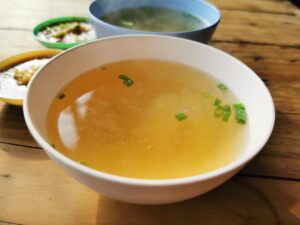
The last day before the procedure was my clear liquids day, and it was a Sunday so luckily I didn’t have to try to do anything much. A clear liquid diet consists of liquids that are transparent at room temperature and leave little to no residue in the digestive tract, such as water, clear broth, apple juice, tea or coffee (without milk or creamer), Jell-O, and sports drinks.
One tricky part of this day was that the prep instructions advised against anything with red dye – apparently that can stain the inside of the colon and cause unnecessary drama during the procedure. But, that rules out a lot of Jell-O and sports drink flavors, so I bought several things I couldn’t actually use! I had 2 packs of Jell-O (one of which turned out to have red dye), several liters of coconut water, various flavored seltzers, and chicken and veggie broth. I alternated between those drinks and plain water all day long. I also ate up my first batch of yellow Jell-O and went back to the store in the afternoon to buy more and made up another batch that I ate in the evening. I’d never had pineapple Jell-O before, but it was pretty good! And had no red dye!
All in all, this part of the prep was easier and went faster than I’d imagined – while I felt a little weird from disrupted sleep and never actually being full, I was never uncomfortably hungry either thanks to a steady stream of Jell-O and fluids. Having several different things to drink, including the savory broth also helped, since when I was getting burnt out on one flavor, I could switch to something different.
In the middle of the day, I texted an old friend from college. He’s had a chronic health condition since his teens that required him to start having routine colonoscopies way back then. I wrote: “Prepping for my first colonoscopy tomorrow – I will never forget you and your gallon of prep solution in our dorm hallway. 🥹 I’m so sorry you had to do this in a dorm bathroom!”
“Good luck!” he texted back. “The preps are much easier now.” And then added a funny story about something wild he’d once said under twilight sedation for a colonoscopy.
If you, like him, have been managing chronic health conditions from a relatively young age, you may have already crossed the bridge of invasive and uncomfortable health screenings by the time you reach your 40s. I am so sorry you had to deal with this so young, and that your peers had so little concept of what you were going through! I hope you too can find a bit of humor in your 40s and beyond watching us, your previously naive peers, hit the wave of age-related health screenings and freak out a bit.
Phase 4 of colonoscopy prep: so much poop!
For the big colonoscopy clear-out, I had what’s called a split prep with sports drinks and Miralax, which I chose because it was the cheapest, and I imagined sports drinks would taste reasonably good. But, there are other options available for this part of the process, so if the description that follows sounds particularly bad to you, ask your team about the alternatives!
The night before my procedure I was directed to drink 2 large bottles of sports drink (in a flavor that didn’t have red dye!) mixed with a bunch of Miralax – I won’t share specific numbers but know that it was a daunting amount! – and to try to consume it all within about an hour. I put the mixture in a big straw cup with a lid and sipped on it while distracting myself with a TV show. I know some people can experience nausea during this phase, but I luckily did not – I think the straw cup may have helped! Within an hour or so of finishing, this brought on a round of on-and-off diarrhea that lasted for about 2 hours that evening, tapering off in time to go to bed early.
The next morning – day of the procedure! – I had to get up very early to drink a 3rd big bottle of sports drink mixed again with a bunch of Miralax, also from my very helpful straw cup, and had the requisite diarrhea after that as well. Hoo boy, that was a lot of Miralax and diarrhea to have all in under 24 hours! While I wasn’t sick, and the copious fluids and electrolytes kept me from feeling dehydrated or dizzy, I did feel pretty depleted and weird after all of that!
This stage of colonoscopy prep was the most uncomfortable part, and I imagine it could be especially challenging for people with disordered eating histories. If that’s you, please talk about your concerns with your support team and your doctor well in advance, and plan ahead for accommodations and coping strategies that might help you manage this phase. Would a dissolve-able nausea medication be OK to use, and would it help you to have on hand? Would it help to have a loved one mix the sports drink and Miralax solution up for you so you don’t have to handle the laxative? Or, would a pre-mixed version be easier? While it would be hard to engage with your professional support team in the middle of this process (and on and off the toilet!), ask them all your questions beforehand. Having a loved one to keep you company during the process could also help a lot – if not in person, then by phone or text.
Phase 5 of colonoscopy prep: procedure day
Other than the sports drinks for prep that morning, my instructions said not to eat or drink anything else prior to the procedure. Deprived as I was of not only food and fluids, but also sleep and caffeine (!!), those last few hours prior to the procedure were uncomfortable, but blessedly short. By this time, I was very eager to get the procedure itself over with!
The nursing staff were very kind and chatty, used to putting anxious-but-sleepy patients at ease. I met the doctor and anaesthesiologist prior to the procedure – they both seemed extremely competent and totally unbothered, like they do 20 of these procedures every day and I was the least interesting (which was probably true). I had full anaesthesia for the procedure itself. I remember the doctor saying “we’re going to take great care of you!” and I remember a split second of feeling intensely tired, and then the next thing I remember is a nurse bringing me ginger ale and snacks in the recovery room. My husband was there as my support person (and my driver!), and told me later that before the nurse came in with refreshments, I’d already had a totally normal-sounding conversation with the doctor and with him, but I don’t remember it at all. Brains are so amazing and weird!
Aftermath
A wonderful thing about a colonoscopy is that while I didn’t feel great when I was done, I wasn’t actually sick. So, as soon as we left, I got a nice big meal and some tea, and started feeling normal very quickly – yay! I was tired but otherwise able to eat and function normally the rest of the day, and went back to work the next day without issue. My GI tract, reunited with my normal rotation of foods, went back to something like my normal bathroom rhythm within a couple of days, but didn’t return all the way to my baseline for more like a week.
Reach out for support
Colonoscopies, like a lot of other health maintenance tasks in midlife, are unpleasant but important. For anyone with a complicated relationship with food who’s planning to undertake this process, the support of a registered dietitian can make it less daunting, so please don’t hesitate to ask! Our team would love to support you in preparing for a colonoscopy, and with the many other challenges that midlife can bring in your relationship with food, health, and your body.
Contact us for support with nutrition during midlife. Our dietitians can meet with you in person in one of our NC offices or via telehealth.